Saturday, May 28, 2011

False Advertising

I get so annoyed by things that are advertised as something they are not.

My scotch tape dispenser proclaims “invisible” tape...and I always thought invisible meant “not able to be seen.”  I would suggest they try terming it translucent, but they are probably still working on making it invisible so renaming it might put a damper on progress.

Then there is the beauty parlor that offers a permanent for my hair. Oddly, I've had close to ten of those permanents and none of them were. Seriously, isn't that false advertising?

I must be the only one who has stared at a wrinkle in a purportedly “wrinkle-free” shirt and said, “Okay, what are we going to name you since you're not supposed to be a wrinkle?” Actually, I haven't said that, but it seems like a fair question for a wrinkle-free shirt that has more wrinkles than a pug.

While we're talking about calling things what they're not I am not going into Taco Bell's “Mexican” food offerings, but only out of respect to my friends who oddly enjoy its...er, hmm...fine cuisine. Or Chinese restaurants that serve French fries and play country music (yes, I have had the misfortune of encountering numerous such establishments). The list of false advertising that I’m not going to address could go on and on. And on.

I wonder if God has the same annoyance. Does it bother Him to see things and people stamped with the description of “Christian” when, in reality, they don't merit the title? If the performance doesn't validate the claims, it sounds suspiciously like false advertising to me. And I think I might be guilty at times—sometimes I might be more of an invisible Christian than Scotch can make their tape. And hair permanents are really no worse than I am about maintaining a lasting transformation. As for Taco Bell's scrumptious “Mexican” food...well, can I complain if it's not authentic? After all, I call myself a Christian—but there are times when I am sadly unlike Christ.

This seems to be a primary complaint of many who object to Christianity—it’s the hypocrisy, our religious word for “false advertising.” I’ve heard many people say, with some sort of accomplishment, that they are bad—but at least they don’t hide it under some veneer. In fact, there seems to be a lot of virtue associated with accepting your inadequacies instead of trying to alter them.

I beg to differ. That makes about as much sense as applauding those clothing companies for shifting their advertising to “We Will Not Lie—Our Shirts Wrinkle Stupendously!” or “Wrinkle-Free is for Wimps—Get the Ones That Wrinkle!”

Instead of renaming wrinkles maybe it would be better to just actually be “wrinkle-free.” The solution isn't to call myself what I am, but to become what I call myself. In life we can either pretend to be something we’re not, just accept what we are and demand accolades for the virtue of being transparent, or start producing products to match the description, so that the advertisement is justified. Sadly, too many of us, Christians included, find the first two options more appealing because they seem to require less effort.

Let’s not forget, though, that we don’t have to do the work alone. It is Christ working through us to transform us, and He promises that “He who has begun a good work in you will complete it” (Philippians 1:6). I’m glad to know that not only do I not have to settle for my weaknesses, but Christ doesn’t leave you or I to do the work alone. He will transform our characters into authentically wrinkle-free Christianity. 

Saturday, April 30, 2011

He Saved Others

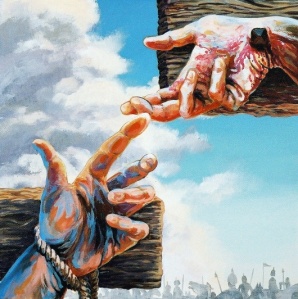
In honor of Mother's Day, just around the corner, and Easter Sunday that is just behind us, I thought this story would be appropriate. Quotes that I have italicized are verses directly from the Bible, but all other references in the story are accurate to the Biblical location and time frame, though I've put my own imaginative spin on it...Hope you enjoy.
The woman stood on Calvary’s hill, transfixed by the scene before her. It was not the first time she had witnessed a crucifixion, but it was the first time someone she loved had been the victim of this brutal punishment.  She more than loved the dying man—she had given life to him, and in all his growing up years she had believed in his potential. He had a good heart and she cherished the thought that he would be a great leader.
            However, his life did not meet the plans a fond mother’s heart had laid out. Despite her attention and concern, he drifted with the wrong crowd, slowly losing respect for Jehovah, the religious ceremonies and traditions, and at last even ignoring the civil laws imposed by the Romans.
            As reports filtered back to her of debauchery, thievery, and riotous living, her heart ached for her son. Often she searched herself for some explanation, some mistake that she could attribute his actions to. Where in his upbringing had she failed?
In spite of the accounts of his wickedness, she who knew him best could not believe that the boy, who even now occasionally displayed affection for his aging mother, was entirely beyond hope. Her discerning heart saw in him opportunity for reform.
But all reflections on the past seemed meaningless now—this was the end. Her son had been condemned to death in the most degrading and cruel fashion of the day by the civil authorities who were anxious to crush all lawlessness and rebelliousness in their subjects.
What could she tell them? That her sweet boy was merely a misguided youth? That he had fallen in with the wrong company, but was not beyond hope? Never could she persuade them that an apparently hardened criminal was not as callous as they supposed. It was true that he had stolen, murdered, and committed a host of other hideous crimes that left her aghast. Nevertheless, she felt he needed a second chance—if he were given a clean slate, surely her boy would never again sully it with another wrong act.
 That was purely wishful thinking, she realized bitterly, for it was obvious that even God had rejected her son. The Pharisees’ and Sadducee’s teachings offered no hope for one who led a life apart from Jewish beliefs and customs, and even she could not defend his lack of interest in the synagogue. The lack of Divine intervention in this case could only mean that her son’s conduct had pushed him beyond the limits of God’s mercy. Her son was doomed, and she had no recourse but to resign herself to his fate—and her own. For what could she blame his decisions on, but the upbringing he had received in her home? The mother knew that the dark cloud already weighing on her soul would stay with her until her grieving heart was stilled by death.
Her thoughts were interrupted by an outburst of jeers by the priests and rulers nearby. “He saved others; let Him save Himself, if He be Christ, the chosen of God.”
The mother turned her eyes for a moment from her son to the Man beside him, the object of the priests’ and rulers’ mockery. With a start, she recognized Him as the Galilean teacher—purported healer and miracle worker. Many had even said Jesus might be the Messiah, and in spite of His hopeless circumstances, some onlookers were even now whispering His deeds and words among themselves as if unwilling to accept the finality of His situation. Was He not being murdered in the same ruthless fashion as her son? What made His condition any different from that of her son?
Watching Jesus, however, the mother knew immediately that there was something different about Him. He was not angry or rebellious; He did not curse the guards, priests or rulers that were taunting Him. His face expressed pity and concern for…could it be for those who were tormenting Him?
“Does Jesus truly not hate these people who so obviously are reveling in their brutality?” She asked almost unconsciously.
“No, he doesn’t,” a tense voice beside her spoke. It trailed off thoughtfully, “Did you hear Him say, ‘Father, forgive them, for they know not what they do…’”
She turned to see the speaker, an older woman who was obviously agonized by the scene. Forgetting her own grief for a moment, the mother put her arm around the other woman in an attempt to console her.
“Perhaps you shouldn’t be here, watching this spectacle,” the thief’s mother whispered. “I can see it is upsetting you.”
“Why is life so harsh?” Tears formed little rivulets down the older woman’s wrinkled cheek.
As her own pain rose to the forefront, the mother sobbed, “My son is the young man dying on the right, and my heart breaks to watch him suffering. Is your anguish even a portion of mine? I cannot expect you to sympathize, but if you only understood…”
She fell silent, her tears flowing unchecked. The older woman at last replied, “I do understand. You see, my son hangs in the middle. His sign reads “The King of the Jews” in mockery, but I believed with all my heart that He is the king, the Messiah we have been seeking.”
Mary’s dim eyes glazed over with a thousand question marks as she looked up at the other mother. “Why then is He on the cross? If only I knew the explanation. I do not know why He is being crucified. What I do know is that He has given sight to the blind, healed the broken hearted, brought the dead to life and preached deliverance from sin. He does not deserve to die this death, but somehow it is as if He knew all the time that this day would come.”
She looked away from her son’s tortured face, and gestured toward the temple gleaming in the light of the setting sun. “Thirty-three years ago I stood in that temple to give an offering for my newborn son, and a holy prophet gave a blessing, spoke of my son’s great destiny, yet warned that a sword would pierce my heart. When Jesus stood in that same temple twenty-one years ago and said that He must be about His Father’s business, I never would have thought this would be part of it.”
The old woman tearfully looked back at the thief’s mother and reached for her hand. “I wish I could be back in the temple with Him, watching Him preach and heal…but Jesus has done nothing except be about His Father’s business. I believe somehow this is a part of the plan…though I do not understand it at all.”
The mother looked in amazement at the Man on the center cross. Could it be that Jesus’ mother was right—or was she only a biased, grieving mother? Was He the promised Savior, or only another false Messiah?
Her thoughts were again interrupted by another taunt, this time by the thief hanging on the left. “If thou be Christ, save thyself and us.”
She ached for Jesus' mother beside her. The jest seemed so cruel to a dying man.
Suddenly she was astonished to see her son struggle to speak, “Dost not thou fear God, seeing thou art in the same condemnation? And we indeed justly; for we receive the due reward of our deeds: but this man hath done nothing amiss.”
Her heart leapt at his words. He was the same soft hearted son she knew and loved, but more than that, he recognized the folly of his ways and was repentant. If only she had the power to offer him another chance!
She also wondered at his statement, “…this man hath done nothing amiss.” Even her son recognized that this Man, this Jesus of Nazareth, was a good and just man. Perhaps the woman beside her was right…
Her boy was speaking again, “Lord, remember me when thou comest into thy kingdom.”
A dying Man to return with a kingdom? Hope burned in her heart as the ancient prophecies came to mind. This gentle, calm Man might truly be divine—the Son of God.
Now Jesus was responding to her dying son’s request, “Verily I say unto thee today, thou shalt be with me in paradise.”
Suddenly, darkness enveloped the throng on Golgotha as an earthquake shook the scene of execution, but a light brighter than any she had ever known glowed in the mother’s heart. A beam from heaven itself had shone from the cross into her despairing soul to say that her son was not lost. He had strayed, but God had never forgotten him. In his darkest hour, her son had received the promise of eternal life from a Man who was dying, but still was divine.
Tears of relief mingled with the tears of sorrow as the mother looked at the older woman beside her. Even in the gloom, she could see the other mother’s face glow with the light of peace. Her Jesus had come for this purpose, not to save Himself, but to save others in darkness.


Saturday, April 16, 2011

The Insurance Policy

The promised second installment to the Theodicy post...

During my time as a Bible worker I spent a considerable amount of time giving surveys to gauge the religious interest in different communities. Among the questions I routinely asked was: "Have you ever wondered, if God is so good, why does He allow so much suffering?" That one in particular generated a plethora of engaging responses, and I often found myself choking back the urge to respond too adamantly.

That temptation came most strongly when the person answering my survey would stare off blankly toward some distant horizon and say, "No, I think we really just bring it on ourselves, you know. I mean, it's the choices we make." Or perhaps, "It's just part of life--it's how we appreciate what is good."

It's a fairly common sentiment, the idea that some sort of bad is a good thing--that it keeps things in balance. I never did really see much value in that concept. I don't have to have food poisoning in order to know how delicious cake and ice cream are. It isn't necessary to have the bad before you can enjoy the good.

Newsflash: There is bad evil in this world. By bad, I mean that you can't always define some cause and then isolate the effect to the perpetrator alone. I completely agree that humanity has brought evil upon itself, but don't pretend that you can take every instance of evil and tell those involved that they brought it on themselves. There are children starving in Africa who are no more at fault for being born into famine than your child in America, England, or Australia was prudent for choosing to be born in a more developed nation.

So deal with the question. Why does God allow bad bad? The kind of bad that doesn't invoke some good moral lesson. The kind of bad that won't be dismissed with "just give it time." The kind of bad that leaves damaged people and damaged places. The kind of bad that demands to be called evil and nothing else. It does exist. But why?

I've asked that question, though I know I haven't seen a fraction of the bad bad in existence on Planet Earth. I've seen enough to know I don't need to see the rest. Somewhere along the line I discovered that bad is really bad. There is nothing good about it.

That's when I realized why God allows bad bad. When He pressed that long term plan "stop evil button," He knew it would never be effective if He filtered out all the serious evil that comes along with sin. Giving us the watered down version would merely teach us that the devil's alternative wasn't so bad after all. If He sheltered us from all the consequences of living in a world where sin permitted evil to mar perfection, we might have some mistaken illusion that bad wasn't really so bad.

However, that can never be the case with Solution X's insurance policy. After thousands of years with unabashed evil acting out in the worst of its nature, humans finally have the knowledge of good and evil that Adam and Eve so unfortunately bestowed upon our race. And that is the only thing that ensures that when God finally eradicates evil forever...it will be forever. There will be no resurgence because humans have known bad bad. Sin will finally have no attraction for them because they were, mercifully, not shielded from its very worst effects.

It's a very expensive insurance policy, but at least it will never expire. Besides, what price can you really put on a perfect eternity?

Sunday, February 20, 2011

Danger Or Rescue


A fat, little frog squatted on the asphalt, enjoying the summer night. There was nothing to disrupt his evening hop across the countryside except the occasional lowing of cattle grazing in the field on the other side of those odd, evenly spaced iron rails that dissected the asphalt trail the fat, little frog was traveling. It was such a peaceful evening that he almost forgot to break the stillness with croaking calls to other frogs that might be taking their evening jaunts.

From the distant lengths of the iron rails, a rattling rumble came tumbling into the fat little frog’s quiet evening. He held tightly to his spot on the asphalt as the rumbling intensified, and in a moment a massive, thunderous machine pounded past him, just 10 feet away, in an eternal procession. The vibrations reverberated in the poor creatures lungs, but couldn’t make the fat little frog quake any more than he already was from sheer fright. If he could think, he was probably wondering if he would live long enough to hatch a plan of escape from the monster machine.

Alas, his evening took a worse turn, if that were possible. Another metal machine with glaring, blinding lights in front was approaching on the asphalt, hissing as it ground to a stop. The fat, little frog blinked as a living creature many times his size left the machine and—horror of horrors—walked toward him. It seemed intent on driving him from his little refuge on the asphalt where he still had not concocted an escape plan, so, in desperation, he fled before the oncoming feet of the advancing creature.

As the fat, little frog disappeared into the grass on the side of the asphalt road, I watched the train blast off into the night; the cross arms blinked goodbye as I strolled back to the car. Listening to the croaking in the grass while I drove across the spot recently vacated by a particular fat, little frog as he had fled before my prodding, I could nearly have imagined his beady eyes bulging from the excitement of his recent escape as he regaled his fellow frogs with the tale of his night of terror.

It amused me that the fat, little frog couldn’t tell danger from rescue. For all he knew, I was just as dangerous as the thunderous train and the hissing, glaring car—in fact, I must have been more frightful, since he held his ground in the presence of those monsters. In his mind, he had narrowly escaped death; and he had. His frantic hopping away from those approaching feet took him out of the path of all the cars waiting to pile over the railroad tracks as soon as the train rumbled into the distance once again.

Some days I feel like thundering monsters are flying by, much too close for comfort; in every other direction it seems like other monsters hiss and glare, while, worst of all, mysterious feet advance, intent on driving me off the little plot of ground I still hold as my own. You know you’ve had those days too, when the obstacles just keep mounting to dizzying heights. Do you, like me, try to pull together some solution, only to find yourself running away from yet another terror?

The amusing part is…we can’t tell danger from rescue either. The most horrifying experiences, the most terrifying of obstacles, might be our safety net from something worse—but, in our finite vision, we never even recognize it. God stands near us, directing us out of the way of pain, difficulty, or sorrow, and our hearts pound with fright because His instrumentalities are lost on our perception. Later we squeak out the tale of our narrow escape from utter ruin and breathe a sigh of relief for having survived the day.

And I think He must smile a bit sadly knowing that the peace we lost through our fear was unnecessarily sacrificed. Another day He may let the terrors fly by us again as He tries to give us faith’s vision that can perceive the difference between danger and rescue.

Saturday, February 5, 2011

Your Local Garbage Dump

While picking over the remnants of some ancient writings of mine, I found this story and thought it might be of interest...       

          I picked my way gingerly past mounds of fly-infested garbage towards something that could only be called a house in purest flattery. Actually I would call it a dump in the form of a trailer-house. The odor greeting my nose confirmed that my eyes and ears had correctly reported dogs and cats in abundance. Honestly, the aroma was about to knock me over. The “door” of the “house”, which I suspected might formerly have been capable of latching decades before I was born, was pushed open to reveal a happy colony of roaches going about their business in the door frame.
            A stained and wrinkled face greeted me in the doorway. Dirty hair hung around a little old woman’s face as she stared at me behind cloudy glasses. A dog lunged past her and through the screen-less screen door. Betty * and her retinue made quite the welcome party.
            Smiling, I held up a bag of food.
            “Hi, Betty,” I said as she took the bag. “I was just bringing you some lunch. Is there anything else you need?”
            This was not my first visit to Betty’s hovel. Ever since the week before, when a customer in my mom’s restaurant where I worked had told me about this poor woman’s living conditions, I had been delivering whatever I could to supplement her diet of bologna and coke.  The sights I had seen (and odors I’d smelled) on these daily deliveries defied any level of poverty I could have imagined in all my 17 years. I was amazed that anyone could live in the sort of filth and squalor I had seen only on TV before this.
            This particular day Betty needed to contact a lady who stopped by to run errands for her sometimes. She hadn’t been by in several days, and I wasn’t surprised to find that Betty didn’t have a phone. Cringing, I handed her my cell phone. One grimy hand pulled her hair aside as my phone was pressed to her equally grimy ear. For a fleeting moment I wondered when she had bathed last, and then recalled that she didn’t have running water.
            Betty handed me back my phone. Gazing off absently, she said, “She didn’t answer.”
            “What did you need her to do? Can I help?” I inquired, mentally scouring my cell phone with disinfectant.
            “I was going to have her bring my dog food into the house. The delivery man was scared of the dog and left it out there,” she said, pointing.
            I looked in dismay at the 40 lb. bag of Beneful near the road on the opposite side of her small “yard.” It had endured the morning’s rain shower—and unlike everything else about this place, it didn’t actually need the bath.
            “Oh, I’ll bring that in for you. It’s not a big deal. Where do you want it?” I volunteered. And carrying it in wasn’t a big deal; the bag wasn’t that heavy. Setting foot in a veritable garbage dump wearing tan jeans was my greater concern.
            After the dog food was relocated (miraculously, without thoroughly staining my jeans), I ran to the local gas station for a few items Betty needed. I had serious suspicions that the money she gave me with which to purchase those items was probably coated with more germs than would be needed for germ warfare on three continents.
            With a final check to see if there was anything else she needed, I waved goodbye to Betty and climbed back in my car. As I pulled out of the driveway, savoring a fresh, clean environment once more, I felt the same incredulous feeling that I always did after a visit to this poor woman’s “house:” How could anyone live, and be satisfied to live, in a place like that?
            From talking to the woman who first told me about Betty, I knew that the poor old woman had lived like this for years. There were people who might have helped her, but she was so accustomed to her way of life that the places that she might have moved she thought were “too good for her.” She was content to live in a run-down dump, leading a filthy, miserable existence with her mangy pets. It wasn’t such a bad place, she seemed to think. After all, this trailer was better than some of the other places she had lived.
            Pulling back into the driveway at my mom’s restaurant, I hurried in the back door and went immediately to wash my hands. I was still mulling over how a person could live in conditions like that, when suddenly I understood. Betty was satisfied with her living standards because to her they were normal. I couldn’t comprehend living that way because I saw those conditions as totally unacceptable—it just wasn’t normal!
            It was right about then that I saw a picture much larger than poor Betty and her filthy little dump. I realized that the whole world was made up people like her, just in a different way. And you and I, more than likely, are living in a worse garbage dump than she is. The problem is that, just like Betty, we don’t know it.
            Our garbage dump is sin in our lives. Before you stop reading because you think I’m referring to non-Christians, wait. I mean you—and me—all of us wonderful Christians who think we’re doing just fine. That is exactly where our problem lies, in the same place as does Betty’s—we believe our life is just fine, normal in fact. Somehow because the world is permeated with this kind of filth, we just don’t notice that it isn’t normal.
            King Solomon knew our biggest problem isn't choosing to do something blatantly horrible and filthy; usually it's just something that seems perfectly normal to our sin-blinded eyes. He say in Proverbs 14:12, “There is a way that seems right to a man, but its end is the way of death.”
            Our mind is the “house” we live in all the time, but do we really know just how dirty and full of germs it is? Like Betty’s house, I think we leave the door to our mental house wide open for all kinds of diseasing elements to enter by what we listen to and watch. We just let the cobwebs build by dwelling on thoughts we know are wrong or savoring feelings of envy, anger and prejudice.
            We have a lot of mangy pets running around like pride, dishonesty and selfishness, but we don’t see how filthy they make our lives. Instead we spend energy feeding these habits until they are healthier than we are. When I am critical of how Betty spends much of her stipend on food for all the little varmints crawling around her place, instead of putting it into some basic necessities like food, clothing and shelter for herself, I have to look at myself and realize how often I am willing to waste the gift of my energies on things that tend to feed those nasty habits.
            Did you ever notice how easy it is to give a few minutes to hunting down some piece of juicy gossip to pass along? Or maybe you tend to use energy carrying a grudge against someone who has wronged you. Perhaps a quick temper likes to raise its head frequently in your life. There are so many of these favorite little “pets” in our lives, and we like to justify them, thinking we have them so well chained up or fenced in that they won’t affect us, but we keep them around because we’ve become quite attached to these pet habits.
            The diet we like to feed our spiritual life is totally unbalanced, just as I know Betty’s diet was not very nourishing, but so long as we aren’t hungry we don’t notice that we have dined on “fillers” that aren’t going to make us spiritually healthy. As Christians, sometimes we are content to make our spiritual menu consist of whatever we learn at church, perhaps what we have been told in school or been taught by our parents; yet our diet is lacking the essential nutrients we can only get from daily personal study.
            I thought about Betty’s life compared to some other conditions…It could be worse. There are people with only a grass hut or no roof over their heads, and many people wouldn’t even have the money to get the bologna and coke. At least she has friends who will run her errands and help her if she wants it. That sort of reasoning makes her situation look better, and that is exactly what we like to do in our lives spiritually. If we can compare ourselves to someone with a worse “garbage dump,” we can even make our situation looks superior, not just a normal, average dump—Why no, ours is a Christian…dump. Yes, it is still a dump.
            At last I had finished disinfecting my cell phone, my purse, the steering wheel of my car, and, of course, my hands. But I still felt dirty, just in a different way. I realized that we all need much more than disinfectant. We need to realize that we live in a garbage dump, not a house. We need to see that our filthy animals, in the form of habits, are diseasing our lives. We need to discover that spiritual food must be nourishing, not just something to fill us. We need to recognize that flies and garbage are not supposed to be normal in our lives, and that spiritually we can be clean. We need to see that no matter how average we think we are, we might have the wrong idea of what is right.
            Only God can show us the true condition that we are in, and make us truly horrified to imagine that we could be satisfied with such a filthy situation. When we see the true standard of living, the way Jesus was, we realize how terrible our garbage dump really is. And our garbage dump may look like a normal Christian life to us, but does it meet up with the standard?
            So that day I began to see a little bit of Betty in me, and if you look hard you might find her hiding inside of you. She might make you think you’re doing just fine, but don’t be fooled by that mentality. You have a garbage dump too, and disinfectant won’t do any good as long as you think you are living in a normal house. Maybe it’s time we asked Jesus to compare our living standards to His and see how they add up.

*Not her real name

Saturday, January 22, 2011

The Stop Evil Button or Solution X

David looked at his class studying the issue of a good God and a bad world and added another point to the theodicy: If there was a "stop evil button" that you could walk up and push, making all the bad in the world cease instantly, would you do it?

I was watching Theodicy, a Scripture mysteries documentary by Anchorpoint Films. Among the interviews, David Asscherick and Clifford Goldstein's comments took me back to seminars of theirs that I had been in and books of theirs I had read that discussed this issue of the problem of evil. The "stop evil button" illustration particularly intrigued me. More than likely, any of us would do it. Yet, ironically, God--the only One who could push the button--hasn't. Why?

As David Hume so succinctly formulated the problem of a good God and a bad world, "Is he willing to prevent evil, but not able? Then is he impotent. Is he able, but not willing? Then is he malevolent. Is he both able and willing? Whence then is evil?" (Hume). The youth class I teach at church discussed this question last week. We talked about the Biblical accounts, especially in Isaiah 14 and Ezekiel 28, of the perfect angel who chose to rebel and wreak havoc on the universe with his accusations against God and his thirst for power. All of that explained how evil originated, but it still didn't answer the question of why God didn't stop it.

Many people I have spoken with have used this as an impenetrable obstacle to any argument that God is good, fair, and just. There seems no intellectually honest avoidance of the question of what possible good reason could exist for why God has allowed horrific things to occur on this planet. Is there any way of justifying it?

Whether it is entirely new or valid theologically, the question and answer I put to the youth class was similar to the "stop evil button" illustration: Think of all the horrors and atrocities on Earth that you abhor, and imagine that there was one penalty that could be paid to end it all--forever. Nothing bad could ever resurface on the radar screen of human existence if you gave the "okay" to this one solution. But there is only the one solution. The solution, whatever it is, likely won't be pleasant in the performance, however it will be permanent. We'll call it Solution X.

Now try to calculate the cost of Solution X. You don't know what it is, so make it as terrible as you can possibly imagine it to be. Can you think of anything that would be too costly an exchange for the permanent eradication of evil? Philosophically I think the question is fairly easy to answer; selfishly, perhaps not. I'm not under the illusion that all, or even most, would honestly be willing to say "yes" to whatever Solution X might be because there are those who would not take a personal sacrifice for the ultimate good. However, many have done so and most, I hope, can appreciate that, logically, there could not be anything worse than eternal evil. Anything less to pay for a permanent solution would probably be better.

So the punchline is...that God did hit the "stop evil button." When He looked at the rebellion the devil had started and knew that destroying him would only eliminate the instigator, but not his rebellion and the issue of evil, the omnipotent and omniscient Creator already understood Solution X. The price was high--it meant letting evil mature so it could be destroyed completely. It meant allowing every horrific thing to happen in the great controversy that would forever convince the universe that the devil was wrong. It meant permitting a part of Himself, His own son, to leave heaven to live, suffer, and die on Earth to redeem humanity from sin. It meant allowing evil its day of power so that it could be eternally terminated. It was Solution X, the only remedy that wouldn't just treat the symptoms but would heal the underlying problem.

God said Solution X was worth it. He hit the "stop evil button," but sometimes, because Solution X requires more time than any individual lifetime, it's hard to appreciate the delayed effect. Someday we will, though, and I'm reminded of this when I read what John wrote in Revelation 21:4 of the end of sin and suffering: "And God will wipe away every tear from their eyes; there shall be no more death, nor sorrow, nor crying. There shall be no more pain, for the former things have passed away."

Note: This is the first part of a two-part post on the topic of theodicy.


Hume, David. Dialogues Concerning Natural Religion. Project Gutenberg. Web. 22 Jan. 2011. .

Saturday, April 10, 2010

Happiness is...


There it was again...decidedly one of the most superficial billboards I'd ever read in my life. A popular fast food chain had the audacity to proclaim "Happiness is...$1-any-size soft drinks" in big, bold letters next to an image of a large Styrofoam cup undoubtedly full of all the empty calories you could want for a dollar.

I was immediately struck with the idiocy of the notion: Happiness is a $1 soft drink? Who do they think they're kidding? If that were true then the whole Revolutionary War probably actually started over soft drinks not tea, since we were simply trying to guarantee "life, liberty, and the pursuit of happiness." $1-any-size soft drinks--was that too much to ask of the British?

Well, the pursuit must be over; anyone in the United States can afford a $1 soft drink--any size, no less! By the logic of this fast food chain, literally the entire United States should be devoid of suicides, heartbreaks, and sadness. All you have to do is run down to the store for a $1-any-size soft drink and--presto!--the world is rosy once more.

Newsflash: We are not all happy. Not even if we've guzzled ten"$1-any-size soft drinks" in a week (or maybe especially not then). In fact, I would hazard a guess that the vast majority have significant amounts of unhappiness that not even a gallon of soft drinks for ten cents could negate. Though some may attempt to drown their sorrows in any number of things, from food and drink to clothes, cars and houses, many will testify that none of it produces any more lasting happiness than a $1-any-size soft drink.

That doesn't mean happiness can't be found--it just means it isn't in material things. To put it in the words of a song by Ira F. Stanphill,

“Happiness is to know the Savior,
Living a life within His favor,
Having a change in my behavior,
Happiness is the Lord.”

King David would have agreed: "Happy are the people whose God is the LORD!" (Psalm 144:15) I guess that children's song back in primary class had more depth than at least one multi-billion dollar advertising department.

Notice that the psalmist doesn't say life will always be rosy. He doesn't say we will never have trials and difficulties. He simply says that we can have happiness as long as we have God--because happiness is the Lord.

He fleshes out this philosophy a bit more in Psalm 16:8, 9: "I have set the LORD always before me; because He is at my right hand I shall not be moved. Therefore my heart is glad, and my glory rejoices; my flesh also will rest in hope."

I'm glad that even when I don't feel happy, knowing the Lord gives me hope to know that happiness is mine, and it doesn't even cost a dollar.